
A LETTER FROM OUR FOUNDER
December 31, 2025
The Path of Most Resistance + Going Through the Motions
Ramblings of a 39-year-old man to close 2025.
There are so many things that I love about strength training.
It’s hard. It’s uncomfortable. It asks something of you when you’d often rather be doing anything else. There are stretches of time where I genuinely don’t want to train most days. And yes—sometimes I’m not fired up, not inspired, not feeling particularly strong or motivated. Sometimes I just have to go through the motions.
That’s probably an unpopular opinion in today’s world, but stick with me.
I want to quit many sets. I want to quit many sessions. That feeling is familiar—and that’s exactly the point. Strength training isn’t designed to be easy. It’s designed to teach us how to push through discomfort in a controlled, intentional way. Life is hard. We often want to quit when things get uncomfortable. Strength training gives us a daily, physical rehearsal for that MOMENT: push through.
We’re often told that wisdom means finding the path of least resistance. Strength training, however, demands the exact opposite.
In technical terms, our minds and nervous systems are constantly trying to find the easiest way out of a task. When a movement gets difficult, the body starts searching for shortcuts. That’s where poor mechanics, compensations, and—over time—injuries tend to show up. The path of least resistance might feel easier in the moment, but it almost always costs us more in the long run.
Here are four common examples we see in the gym, what’s actually happening under the hood, and why they matter.
1. Fast, uncontrolled negatives
Lowering a weight quickly feels easier because it shifts work away from the muscles we’re trying to train. Instead of controlling the descent with muscle tension, we rely on gravity and momentum. The nervous system loves this shortcut.
The problem? The muscles that should be absorbing force—like the quads in a squat or the lats and biceps in a pull—aren’t doing their job. Connective tissues take more stress, joint control decreases, and strength gains stall. You might finish the set faster, but you lose the very adaptation you came for.
2. Avoiding full range of motion
Partial reps feel strong. They let us move more weight and avoid the most uncomfortable positions. But again, the nervous system is choosing the shortcut.
When we avoid full range of motion, we limit strength development, reduce joint resilience, and teach the body to stay weak in certain positions. The muscles that should be working hardest at end ranges never fully adapt, leaving us less capable—not more.
3. Knees caving in during squats
This one shows up when things get heavy or fatigue sets in. As the body searches for an easier path, the knees collapse inward. Typically, this means the glutes—especially the glute medius—are checking out, and the adductors and smaller stabilizers are trying to pick up the slack.
Over time, this compensation increases stress at the knees and hips and reinforces poor movement patterns. The “easier” way out slowly becomes the risky way forward.
4. Rounded back or loose core
When the core disengages under load, larger global muscles try to compensate. The hips, spinal erectors, or even the shoulders start taking on stress they weren’t designed to handle alone.
This often feels “strong” in the moment but erodes stability over time. A braced, intentional core is harder to maintain—but it’s the path of most resistance, and it’s the one that keeps us durable.
That’s the technical side.
Now zoom out.
The same principle shows up everywhere else in life.
We live in a culture obsessed with immediate gratification. Something breaks—replace it. Something feels hard—avoid it. A relationship gets difficult—find a new one. A job or boss doesn’t make us feel the same way it once did—move on.
And sometimes, those decisions are necessary. But far too often, we default to the easiest exit simply because it’s uncomfortable to stay.
The rub is this: most things worth anything in this life require long, hard, often boring work. Be wary of shortcuts, get-rich-quick schemes, and magic solutions. Doing things the slow, demanding way is increasingly frowned upon.
It reminds me of the old story of the tortoise and the hare. The real question isn’t about speed—it’s about direction. Are we moving quickly, or are we moving intentionally? I’ve had this exact conversation with a few men in my circles lately, and it keeps coming back to the same truth: progress compounds when direction is right, not when pace is flashy.
Which brings me back to the idea of sometimes just having to go through the motions.
There are seasons where motion is all I have. And honestly—what’s the alternative? Just not show up? I’ve found that when the drive or excitement fades in certain areas of life, the best practice is to put my head down and keep moving until the joy returns. And it always returns. Sometimes in days, sometimes weeks, sometimes months.
But if I stop showing up—whether that’s in training, relationships, quiet time seeking to grow my walk with God—I fall out of the routines I’ve spent years building. And here’s another hard truth: it’s far harder to restart something than it is to simply keep it going.
Going through the motions gets a bad rap. And to be clear, this isn’t an invitation to live your life on autopilot. But when motivation disappears, consistency becomes the win. Motion preserves the habit. Habit preserves the identity.
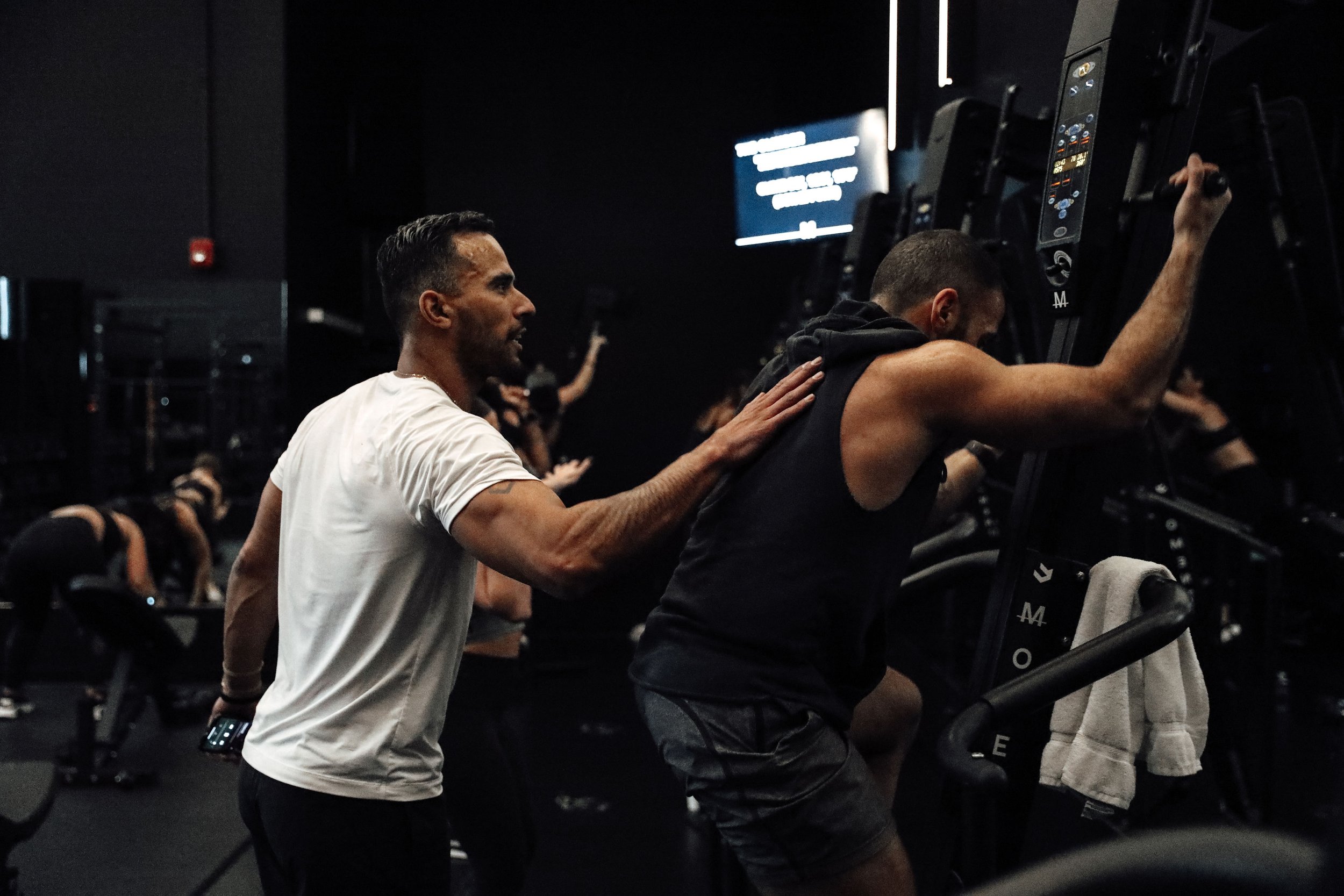
Thanks for making it this far through my ramblings. As the years go on—and as I gain more experience as a father and husband—these reflections will undoubtedly get longer. Be thankful you’re not my wonderful wife (Kati Rodriguez), who has to deal with them 365 days a year. She’s the heartbeat of TRAIN Moment and the reason we are where we are today. She sits in the background, gets little credit, and yet her heart and drive are why you know us, love us, and occasionally hate us (hopefully just the VersaClimber).
As we step into 2026, may we be a Community that seeks the path of most resistance—and goes through the motions when needed.
Cheers to doing hard things. Together. Even when we don’t want to.
In Strength + Blessing,
Nik Rodriguez
